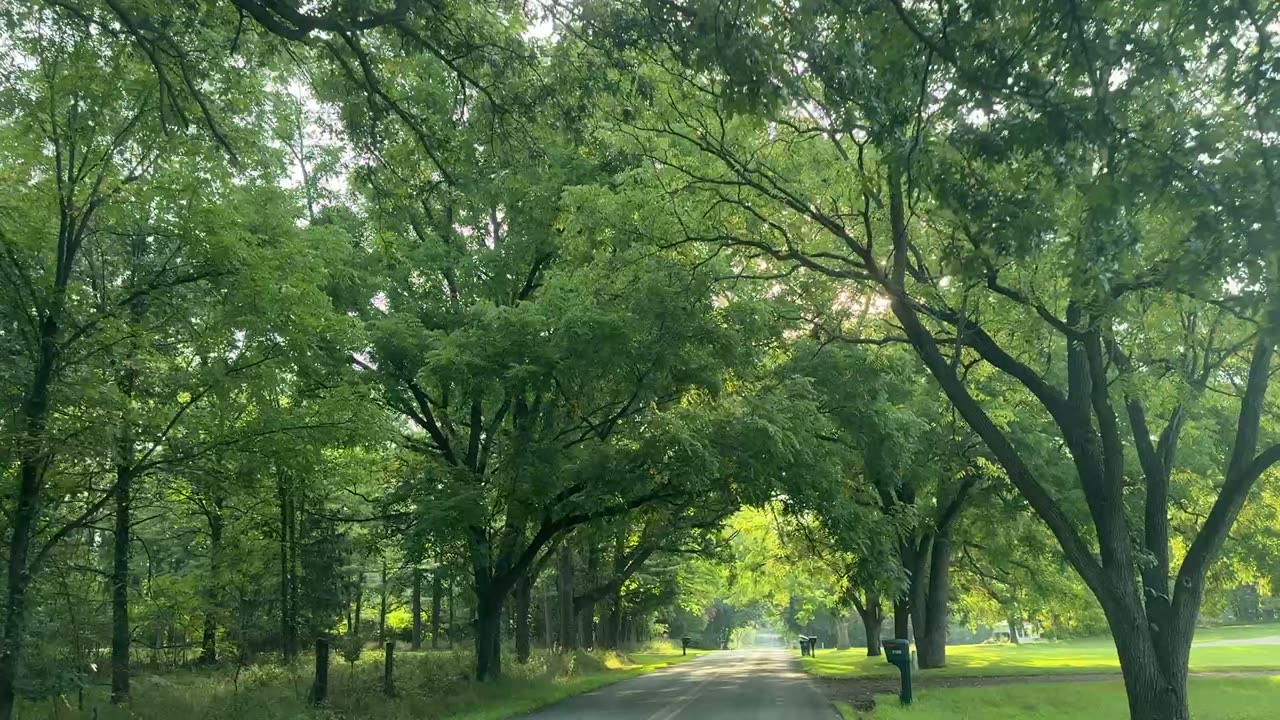
This is the drive home.
We are the people who live along these roads, and we would like to be asked.
8,000 trees along these roads are marked to come down. Nobody elected the five people who decided it.
They meet Tuesday, September 8, at 3 p.m. We need to be in that room together.
Can’t make it? Send me what happens.
No sign-up, no speaking required. Here’s exactly what happens in the room →
Publish the list.
The Road Commission announced a reduction. It has not published a list.
It has not identified a single tree that came off the plan. It has not allowed anyone independent to check. There is no verified count — not 8,000, not 4,000, not any number. There is only an announcement.
8,000 was their figure before July. 4,000 is their figure now. Both numbers came from the same agency, and neither one comes with a document.
Every marked tree in this county has a number painted on it. Homeowners have been describing those numbers all summer — not just an X, but an X and a number. We would like to know what those numbers refer to.
What we are asking for
- The list of every tree scheduled for removal, by road and by the number painted on it.
- The list of every tree that came off the plan in July, by the same numbers.
- The criterion each decision was made against, and who made it.
- Published on the Road Commission’s own website — not sold to whoever can pay for it.
We will publish whatever they release, here, in full and unedited — including if it turns out to support their position rather than ours.
A resident did ask. In place of the federal grant application, the Road Commission quoted that resident a fee of roughly $1,000. Michigan’s Freedom of Information Act allows a public body to charge for records, so the fee is not the scandal. The point is simpler: a document the public paid to produce, about 8,000 trees on the public’s roads, is currently available to whoever can pay a thousand dollars for it — and it could be posted on their website tomorrow for nothing.
Why we put up with the winters
There is a reason people stay in Kalamazoo County, and it is not February.
It is the drive out in the third week of May, when the canopy closes over the road and the light goes green. It is the shade on the shoulder where the bus stops. It is the fact that the road you take to work looks like something instead of nothing.
Somebody left those trees standing for us. Most of them were putting down shade before anyone reading this was born, and not one was planted by a person who expected to sit under it.
That is not decoration. That is home. This is our heritage.
The strip in front of your house
You mow it. You rake it in November. You shovel the end of it every time the plow comes through, and when a limb comes down you drag it off yourself. You pay taxes on the parcel it sits in. When you bought the house, those trees were part of what you were looking at.
Nobody asked you.
No letter. No hearing. No vote. No form. One day in May there was orange paint.
We are not going to argue with you here about who owns what — that depends on your road, your deed, and a survey, and there is a page about it. What we will say is simpler, and we think most people in this county already know it: whatever the paperwork says, that strip is part of your home. You have looked after it for years. You should have been asked.
Is your tree marked?This site is written by residents who live on these roads. If you email us, one of us answers it.
Nobody voted for the people doing this.
The Road Commission of Kalamazoo County is five people. None of them is elected. They are appointed, and they set their own policy on which trees come down.
There was no public hearing on removing these trees. There is no appeal if yours is marked. There is no independent auditor checking whether the agency follows the policy it wrote for itself. When the Road Commission presented this project to the public, it said in advance that it would not take questions that night.
Whatever you think about trees, that is how this was decided.
332 of 342 people with marked trees said no one consulted them. Their words →
What we’re asking for →The people who appoint them weren’t told either.
The Road Commission won a $25 million federal grant in September 2025.
The Kalamazoo County Board of Commissioners — the nine elected people who appoint every road commissioner — did not receive a presentation on this project until July 2026. That presentation happened after residents raised it at a county board meeting in June. No vote was taken on it.
So for the better part of a year, the only body a resident could vote for did not know that 8,000 trees along county roads had been slated for removal.
And when the county board did finally hear it, one commissioner said plainly on the record what the board’s power actually amounts to: the Board of Commissioners does not control what the Road Commission does, and its only influence is whether it reappoints Road Commission members.
One of those five seats comes up on December 31, 2026.
Three.
The Road Commission’s case is built on a percentage. In its presentation, 60% of fatal and serious crashes in Kalamazoo County are lane departures, and 60% of those involve trees.
At a county board meeting this summer, Chairperson Jen Strebs went and checked that percentage against the eleven roads where the trees are actually marked.
Across five years, on those eleven roads, the Road Commission’s own safety action plan identified three serious or fatal crashes involving trees. Two of the three also involved intoxication and wet conditions.
She asked the county engineer how sixty percent could describe roads where the plan itself found three. From the minutes, his answer was that the figure came from “looking at all the data and coming up with a county-wide average.”
Her reply, recorded: an extrapolated average.
Three is not zero. People were hurt on these roads and we are not going to pretend otherwise — it is exactly why the money should go where the crash record actually points, which is what the Road Commission’s own presentation says rumble strips do at a 55% reduction, on all 130 miles, regardless of a single tree.
What we object to is a county-wide number used to describe eleven specific roads, to the people who live on them, until somebody checked.
Read the minutes →Open the full map — easier to use on a phone.
Find your road.
Eleven routes. One hundred thirty miles. Fifteen townships. Five years.
Most people we talk to had no idea their own street was on the list. That was true of us until the orange X’s showed up in May.
And the map is not the whole story. The Road Commission has been marking trees on roads that were never part of this project at all. When residents on M Avenue asked why their trees were marked, a Road Commission staffer told them the agency is trying to clear roadsides wherever it can. They took roughly 1,500 trees in 2025.
8,000 is the floor, not the ceiling.
Is your tree marked?What the Road Commission is doing
In September 2025 the Road Commission of Kalamazoo County was awarded $25 million through the federal Safe Streets and Roads for All program — the largest such grant in Michigan and, by the agency’s own account, the tenth largest in the country.
The money pays for centerline and shoulder rumble strips, edge-line markings, curve signage, some shoulder widening and paving — and the removal of every tree the agency classifies as a fixed object inside the clear zone along 130 miles of county primary roads.
In its own FAQ, the Road Commission put it this way: trees within 33 feet of the road centerline “are classified as fixed objects and will be removed as part of clear-zone safety work,” and the agency “is not replacing removed trees at this time.”
Cutting is reported to begin October 1, 2026.
“But didn’t they cut it to 4,000?”
They said so, this summer. They then posted a revised clear-zone policy on their SS4A page: 17 feet from the outside white line instead of 33 feet from the centerline. Where there’s no white line, 17 feet from the edge of the pavement — which takes more.
Here is what they did not publish: a list of which trees came off.
There is no published inventory, no independent audit, and no third-party auditor of any kind to check whether the agency follows its own policy. Residents are reporting healthy trees still wearing an X well outside the new zone, and dead trees that were never marked at all.
We are not going to run this campaign on a number an agency can revise again next month without telling anyone. Until then, we count 8,000.
Send the letterWhat a reasonable outcome looks like
Most people in this county, whatever they think of trees, would sign their name to three things:
- The curves and intersections with an actual crash record get fixed, and get fixed first
- The county does not spend federal money doing more than the crash record calls for
- Before an agency removes something from in front of your house, you are told, and there is somewhere to go if they have it wrong
That is the whole ask. If you would sign that, you agree with us, and the rest of this page is detail.
We’re two people from Kalamazoo County who noticed the X’s
It started when the orange X's appeared in May. Neighbours on one road started asking each other what they meant, then started calling the Road Commission, then started finding each other. Nobody planned this. It is residents who found out the same way you probably did.
We are not lawyers, arborists, or engineers. Everything technical on this site comes from the Road Commission’s own documents, which are linked, or from people we name.
Here’s what we’ll say against our own interest: these roads do have a real crash record, and the Road Commission has a real job to do about it. We are not claiming otherwise. What we are saying is that the agency’s own board minutes show only three serious or fatal tree crashes on these eleven routes across five years, and that the cheapest, best-evidenced fix in its own presentation is rumble strips — which are already going in on all 130 miles either way.
Showing up has already changed things
Since residents started attending board meetings and writing to the County Board:
- The Road Commission revised its clear-zone policy, and some trees came off the list
- Saved trees have had their X’s painted over in black
- The agency has re-surveyed trees for residents who spoke at board meetings and left their contact information
- It adopted an 18-month pilot to cost-share replacement trees 50/50
Where this stands:
- Roadside Neighbors so far: 2,153, and 343 with trees marked — counted at the end of August 2026. 2,088 people had signed the petition when it was delivered to the Road Commission in mid-July 2026.
- About 50 residents came to each of the first two Road Commission board meetings. Both rooms were full.
The board meets in a room that holds more than fifty.
None of that happened because anyone sent an angry email. It happened because people showed up, in person, and put their names down.
One more thing we learned the hard way: emails sent only to the Road Commission went largely unanswered. Emails that copied the Kalamazoo County Board of Commissioners got responses within days — and led directly to a sit-down between residents, Road Commission officials, and two county commissioners.
What we’re doing next
Public records requests. Pressure on the County Board, which appoints every Road Commission commissioner. And, if it comes to it, an injunction under Michigan’s environmental protection law.
How that works, and what it needs →
Write to the Road Commission and your county commissioner →
Join 2,153 Roadside Neighbors
We post after every board meeting, whether it went our way or not.
Two minutes, and we’ll know how to reach you.
Have you already signed our petition or filled out one of our forms?
If this goes the way it should
Five years from now the road past your house looks about the way it looks today. The curve where the crashes actually happened has a guardrail and a wider shoulder. The rumble strips are in. The water is off the road in April. The bus still stops in the shade.
That is not a dramatic outcome. It is an ordinary one, and it gets decided in a public room on a Tuesday afternoon.
Nobody plants a roadside oak for themselves. The ones standing out there now were left to us by people who knew they would never sit under them.
I'll be there September 8